
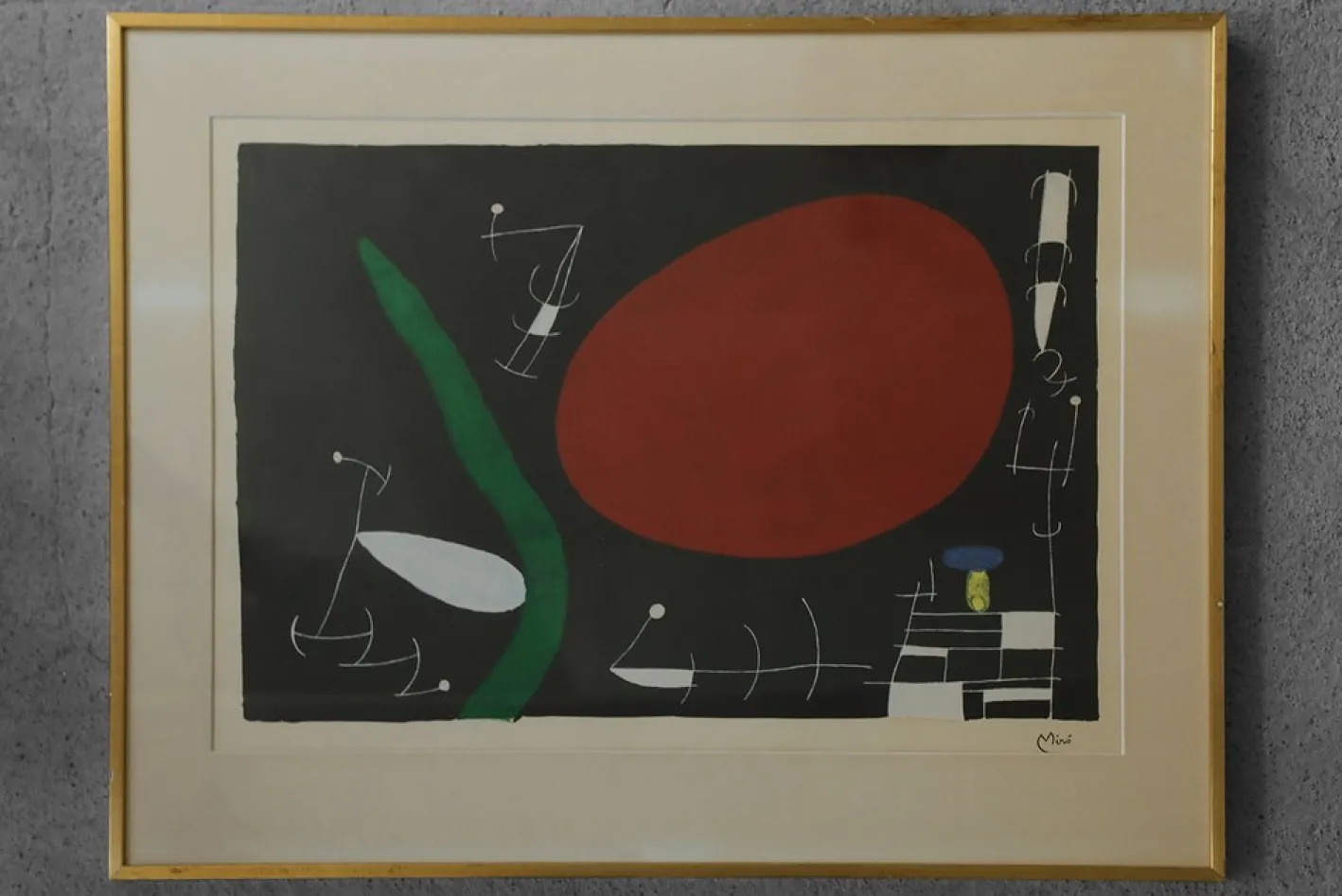
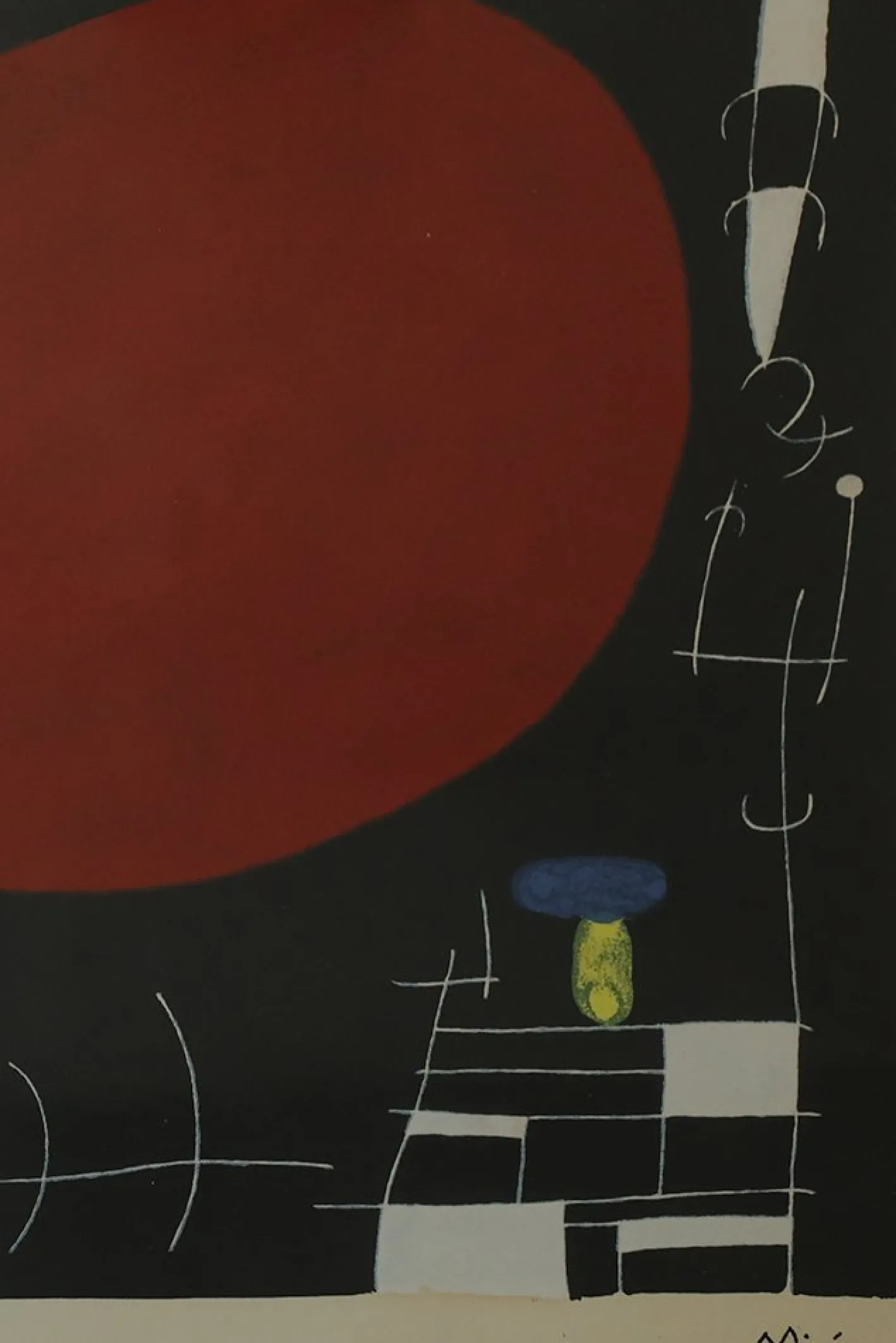
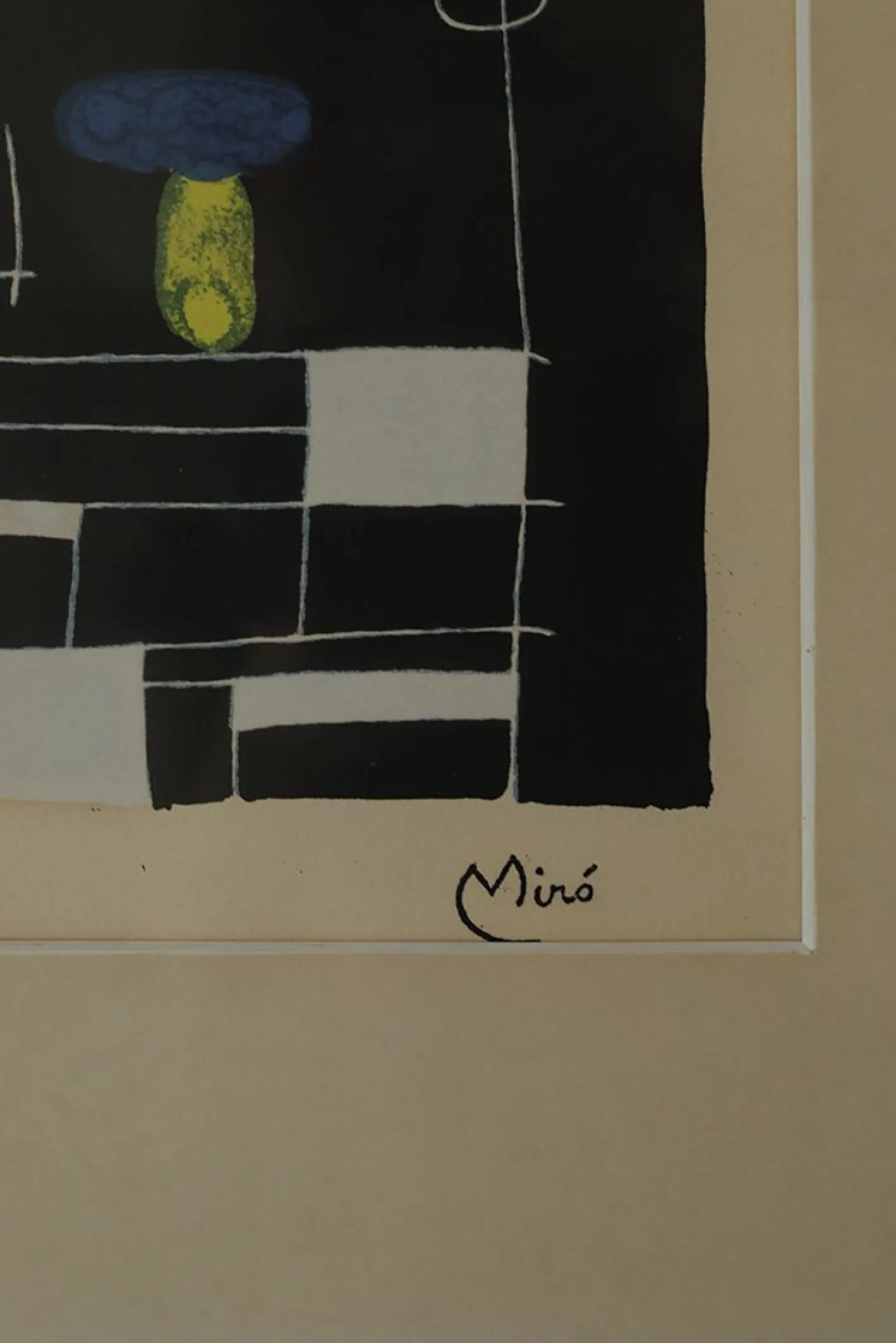
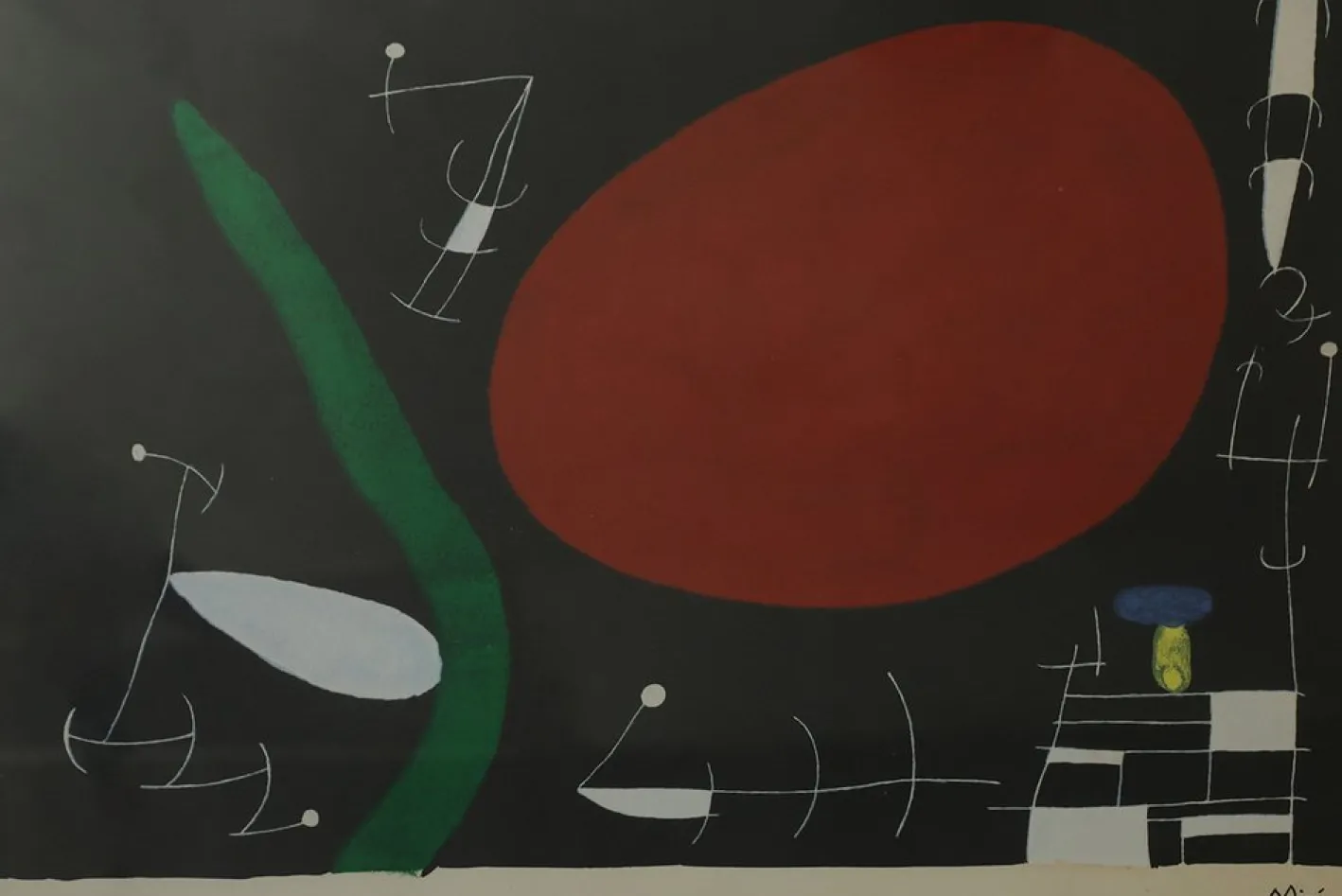
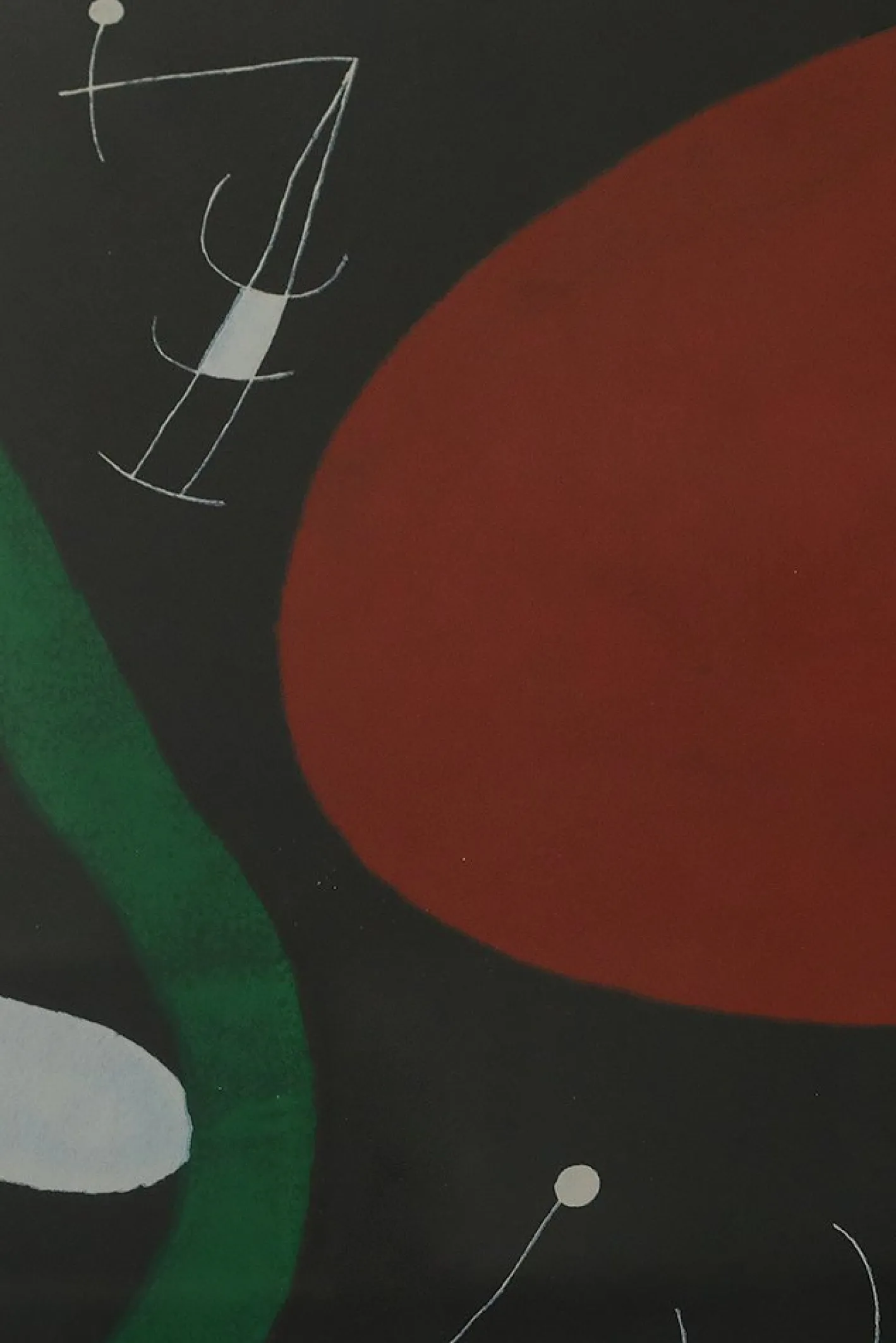
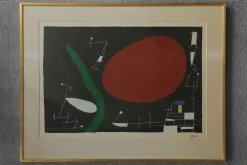
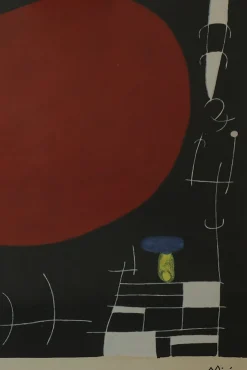
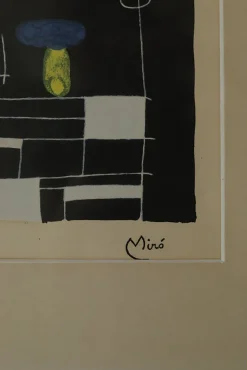
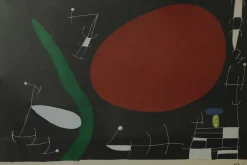
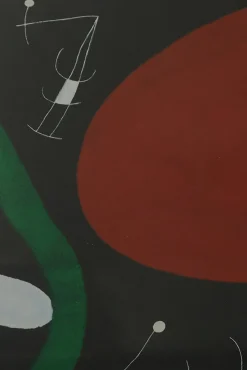
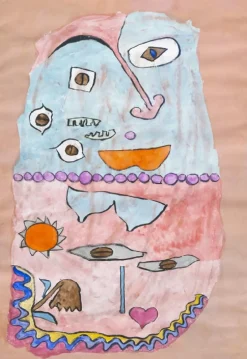
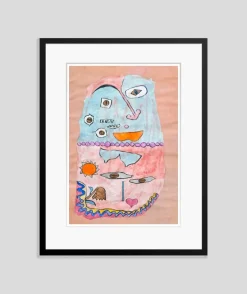
Joan Miro, Sun and Sparks, 1960er, Farblithographie, Gerahmt
Original price was: €1,379.44.€104.05Current price is: €104.05.
Joan Miró, Soleil et Étincelles, 1960s
Color lithography
Work signed in print
Work dimensions 58/74
The work is framed
This lithograph appeared in the collection Derriére le Miroir 164/165. L’Oiseau Solaire, L’Oiseau Lunaire, Etincelles published by Galeria Maeght in 1967. Lithograph by Joan Miró, a Catalan painter, sculptor and ceramicist. The surrealist master is one of the most important Spanish artists of the 20th century and one of the greatest artists of contemporary art.
A picture is made of brushstrokes, just as a poem is made of words. – Joan Miro
Miró’s works are interpreted as belonging to surrealism, as an expression of a return to childhood and as sandboxes for the subconscious. The Miró style consists of vivid colors combined with simplified forms, reminiscent of drawings of a small child. Initially, Miró created in various fashionable styles, for example, Fauvist and Cubist. In 1920 he traveled to Paris several times, and a year later he settled there permanently. He met Pablo Picasso, Vasily Kandinsky and many other outstanding artists. In 1924 he joined the surrealists of André Breton’s circle, but – despite the fact that he worked under their influence – he remained on the outskirts of this trend, maintaining the position of an outsider.
Influenced by Surrealist poets and writers, he began to develop his own style: a map of weightless colored signs and poetic forms that evoke both the seemingly naive freshness of invention and the exuberant and baroque Catalan spirit. The elements of the style adopted by him were organic forms and a flattened drawing with sharp lines. With the help of a symbol, a trace of a finger, a hand, water on paper, a seemingly delicate line on fabric – the master transformed the world around him with clear simplicity. He created a reality full of poetic and dreamlike transformations.
His lifestyle had a great need for cleanliness, order and education. The studio was tidy, and the works were arranged according to a system known only to the artist. He grew up in Barcelona, spent part of his life in Paris, and although in 1956 the artist decided to move to Palma de Mallorca and Villa Son Abrines, his life continued to follow the Barcelona-Parisian rhythm. The choice of Palma de Mallorca was also not accidental, because his wife – Pilar Juncosa – was born on this Mediterranean island.
Often the starting point of Mirò’s paintings is the main color spot from which the world emerges with the strict organization of its irrational form. However spontaneous this creation may seem, only the first moment was created freely, the rest is meticulously controlled according to Miró’s requirements for balance in the composition. Freeing his paintings from illusions and anecdotes, Miró has reached the limit of simplification. He is the author of the grattage painting technique, which consists in scraping the paint off the canvas.
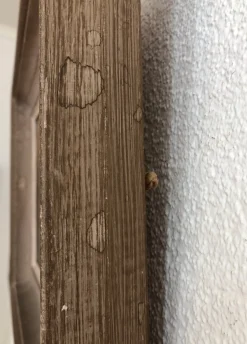
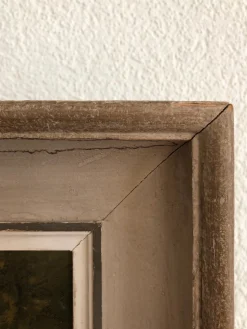
Work in original vintage condition. The frame shows slight traces of use.
The colors of the products shown in the photos may differ slightly from the actual ones. This is due to individual monitor settings and lighting conditions – the photos were taken in artificial light, which may affect the perception of colors. However, we strive to ensure that the photos reflect the actual appearance of the product as faithfully as possible. The offer may include photos of item in the living space, but these are for illustrative purposes only.
Joan Miró, Soleil et Étincelles, 1960er Jahre
Farblithographie
Werk im Druck signiert
Maße des Werks 58/74
Das Werk ist gerahmt
Diese Lithographie erschien in der Sammlung Derriére le Miroir 164/165. L’Oiseau Solaire, L’Oiseau Lunaire, Etincelles, herausgegeben von Galeria Maeght im Jahr 1967. Lithographie von Joan Miró, einem katalanischen Maler, Bildhauer und Keramiker. Der surrealistische Meister ist einer der bedeutendsten spanischen Künstler des 20. Jahrhunderts und einer der größten Künstler der zeitgenössischen Kunst.
Ein Bild besteht aus Pinselstrichen, so wie ein Gedicht aus Worten besteht. – Joan Miro
Mirós Werke werden als dem Surrealismus zugehörig, als Ausdruck einer Rückkehr in die Kindheit und als Sandkasten für das Unterbewusstsein interpretiert. Der Stil Mirós besteht aus lebhaften Farben in Kombination mit vereinfachten Formen, die an Zeichnungen eines kleinen Kindes erinnern. Anfänglich schuf Miró in verschiedenen modischen Stilen, z. B. im fauvistischen und kubistischen Stil. 1920 reiste er mehrmals nach Paris, wo er sich ein Jahr später dauerhaft niederließ. Er lernte Pablo Picasso, Wassily Kandinsky und viele andere herausragende Künstler kennen. 1924 schloss er sich den Surrealisten um André Breton an, blieb aber – obwohl er unter deren Einfluss arbeitete – am Rande dieser Strömung und behielt die Position eines Außenseiters.
Beeinflusst von den Dichtern und Schriftstellern des Surrealismus begann er, seinen eigenen Stil zu entwickeln: eine Landkarte aus schwerelosen farbigen Zeichen und poetischen Formen, die sowohl die scheinbar naive Frische der Erfindung als auch den überschwänglichen und barocken katalanischen Geist hervorrufen. Die Elemente des von ihm gewählten Stils sind organische Formen und eine flache Zeichnung mit scharfen Linien. Mit Hilfe eines Symbols, der Spur eines Fingers, einer Hand, Wasser auf dem Papier, einer scheinbar zarten Linie auf dem Stoff – der Meister verwandelte die Welt um ihn herum mit klarer Einfachheit. Er schuf eine Realität voller poetischer und traumhafter Verwandlungen.
Sein Lebensstil hatte ein großes Bedürfnis nach Sauberkeit, Ordnung und Bildung. Das Atelier war aufgeräumt, und die Werke waren nach einem System angeordnet, das nur der Künstler kannte. Er wuchs in Barcelona auf, verbrachte einen Teil seines Lebens in Paris, und obwohl der Künstler 1956 beschloss, nach Palma de Mallorca und in die Villa Son Abrines zu ziehen, folgte sein Leben weiterhin dem Barcelona-Paris-Rhythmus. Die Wahl von Palma de Mallorca war auch deshalb nicht zufällig, weil seine Frau – Pilar Juncosa – auf dieser Mittelmeerinsel geboren wurde.
Ausgangspunkt von Miròs Gemälden ist oft der Hauptfarbfleck, aus dem die Welt mit der strengen Organisation ihrer irrationalen Form hervorgeht. Wie spontan diese Schöpfung auch erscheinen mag, nur der erste Moment wurde frei geschaffen, der Rest ist akribisch kontrolliert, entsprechend Mirós Anforderungen an das Gleichgewicht der Komposition. Indem er seine Bilder von Illusionen und Anekdoten befreit, hat Miró die Grenze der Vereinfachung erreicht. Er ist der Erfinder der Grattage-Maltechnik, bei der die Farbe von der Leinwand abgekratzt wird.
Werk in originalem Vintage-Zustand. Der Rahmen weist leichte Gebrauchsspuren auf.
Die Farben der auf den Fotos abgebildeten Produkte können leicht von den tatsächlichen Farben abweichen. Dies ist auf die individuellen Monitoreinstellungen und Lichtverhältnisse zurückzuführen – die Fotos wurden bei künstlichem Licht aufgenommen, was die Wahrnehmung der Farben beeinflussen kann. Wir bemühen uns jedoch sicherzustellen, dass die Fotos das tatsächliche Aussehen des Produkts so getreu wie möglich wiedergeben. Das Angebot kann Fotos des Artikels im Wohnbereich enthalten, die jedoch nur der Veranschaulichung dienen.
Klicken Sie hier für die vollständige BeschreibungSchließen
| Epoche | 1960 bis 1969 |
|---|---|
| Produktionszeitraum | 1960 bis 1969 |
| Hergestellt in | Frankreich |
| Kennzeichnung vorhanden | Dieses Stück verfügt über eine Kennzeichnung |
| Stil | Abstraction, Surrealismus, Vintage |
| Zustand | Gut — Dieser Vintage/antike Artikel kann einige Gebrauchsspuren wie Kratzer und andere Zeichen der Zeit aufweisen. |
| Details über Schäden und Restaurierungen |
Leichte altersbedingte Gebrauchsspuren, Altersbedingte Patina, Der Rahmen weist leichte Gebrauchsspuren auf
The frame shows slight traces of use
Automatisch generierte Übersetzung |
| Artikelnummer | ZAA-1736068 |
| Material | Lithografie |
| Farbe | Schwarz, Rot |
| Breite | 74 cm 74 cm |
| Tiefe | 3 cm 3 cm |
| Höhe | 58 cm 58 cm |
Be the first to review “Joan Miro, Sun and Sparks, 1960er, Farblithographie, Gerahmt”
Related products
Jugendstil
Druckgraphiken Und Multiples
Abstraction
Impressionismus
Reviews
There are no reviews yet.